


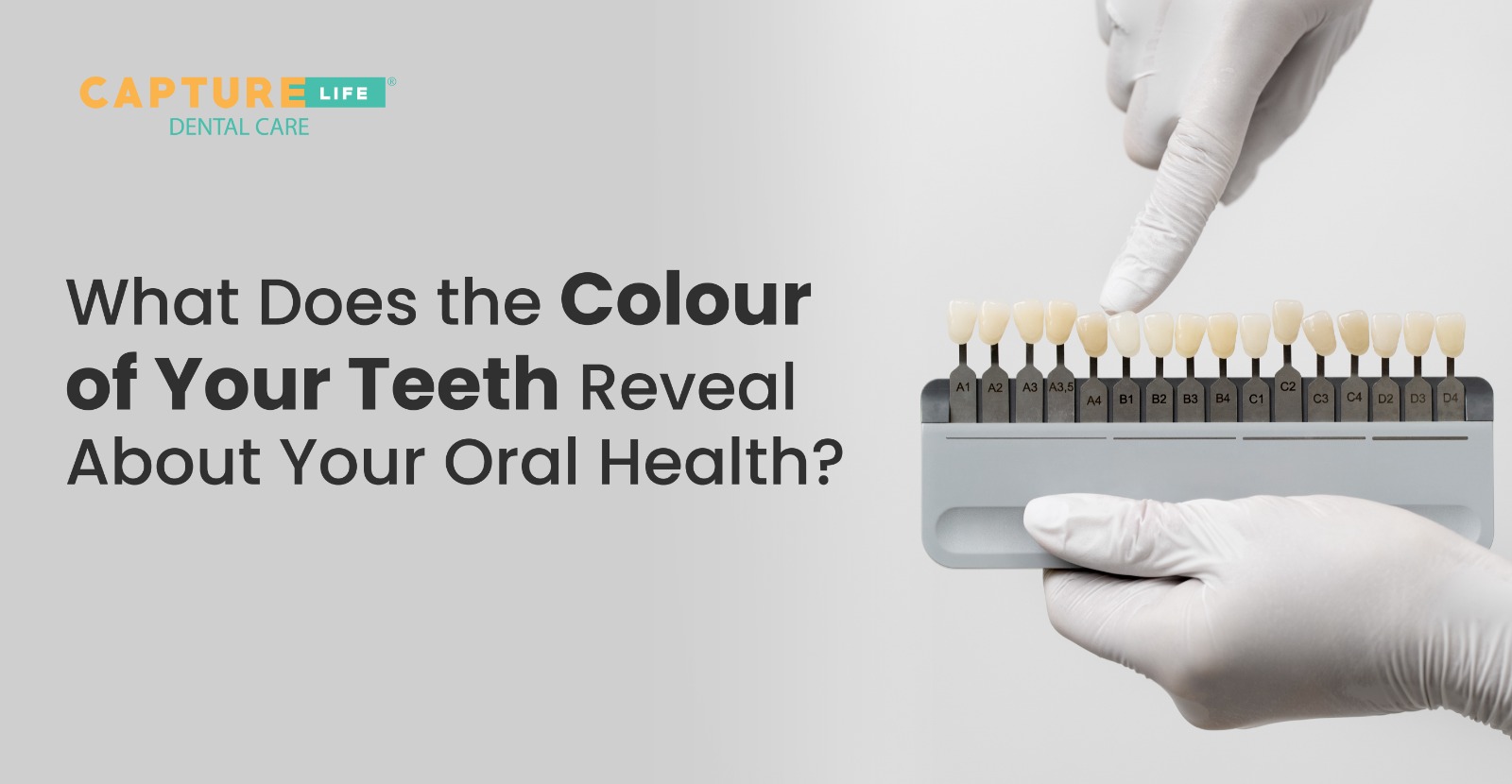
30 May What Does the Colour of Your Teeth Reveal About Your Oral Health?
Most of us glance at our teeth and ask the same question: are they white enough? It’s almost always the first thing we notice, and the first thing we want to fix. But tooth colour is actually telling you something far more than whether you need a whitening kit.
Some of what you see is completely harmless. Some of it is worth acting on. And knowing the difference? That’s where it gets useful.
Healthy Teeth Aren’t Pure White
This surprises a lot of people. But a bright, paper-white smile isn’t actually what naturally healthy teeth look like.
Every tooth has two main layers, and understanding both helps explain a lot about why your teeth look the way they do.
The outer layer is enamel, the hardest substance your body produces, even stronger than bone. It forms a protective shield over the entire tooth, guarding against daily wear. Despite being incredibly tough, enamel is also surprisingly thin, only about two to three millimetres at its thickest point. It’s semi-translucent, meaning light passes through it rather than bouncing straight off. This is why teeth don’t appear bright white, you’re actually seeing through the enamel to some degree.
Beneath the enamel sits dentine, a softer, more porous layer that makes up the bulk of the tooth. Dentine is naturally yellow in colour, and it plays an important role in supporting the enamel above it. Because it’s softer, it’s also more vulnerable once enamel wears away, more sensitive to temperature, more susceptible to decay, and quicker to absorb staining.
The interplay between these two layers is what determines your natural tooth colour. As enamel thins over time, more of the yellow dentine beneath becomes visible. Some people are also born with naturally thinner enamel, meaning their teeth have always leaned a shade towards yellow, and that’s perfectly normal.
So before you reach for the whitening strips, it helps to understand what your teeth are actually trying to tell you.
Yellow Teeth
Yellow is the colour people ask about most. And whether it’s a concern really comes down to the cause.
Surface Staining
Tea, coffee, red wine, the everyday pleasures. These leave pigment on enamel over time, gradually dulling the surface. The good news is that surface stains sit on the outside of the tooth. They don’t damage the structure underneath, and they respond well to professional cleaning.
Enamel Thinning
This is a different conversation. When enamel wears away, through acid erosion, age, or brushing too hard, the yellow dentine beneath becomes more visible. This kind of yellowing often comes with a companion: sensitivity. Cold water feels sharper. Hot drinks sting a little. That’s your tooth signaling that something has changed.
Enamel doesn’t grow back. Our body stops producing enamel after our permanent teeth erupt. So, catching this early means you can slow down enamel thinning, but it does need attention.
Brown Stains
Brown tends to sit deeper than regular surface discolouration. It can show up as patches, lines near the gumline, or a spot that keeps reappearing in the same place.
Tobacco is one of the most common culprits. Nicotine and tar work themselves into enamel over time, leaving marks that brushing alone won’t shift. But brown stains can also signal something more significant: early decay. A spot that feels slightly rough when your tongue runs over it, or one that doesn’t shift with brushing, could be a cavity forming.
Hardened tartar near the gumline can also take on a brownish tone. Once plaque hardens, only a professional cleaning can remove it.
Any spot that keeps returning in the same location is worth mentioning to your dentist.
White Spots
A chalky white patch sounds like it should be fine. It usually isn’t. Dull, white areas on the tooth surface are often the earliest sign of enamel weakening, just before decay starts to develop. The surface hasn’t broken through yet, but mineral content has been lost and the enamel has become vulnerable. Caught at this stage, the process can sometimes be slowed. Left alone, it tends to progress.
White spots can also result from excess fluoride during childhood, enamel that didn’t develop fully, or chronic dry mouth. They’re easy to overlook, but a dentist spotting them early can significantly change what happens next.
One Tooth Going Darker
When a single tooth turns noticeably darker than those around it, that’s rarely a surface issue.
Old trauma is the most common reason. When blood vessels inside the tooth rupture, the pigment gradually absorbs into the tooth structure and it slowly darkens. This can take months to appear, which is why people are often caught off guard.
A tooth that sits clearly different from the rest is always worth mentioning, even if there’s no pain.
Black Spots
Black discolouration is almost always advanced decay or significant tartar buildup and neither improves without treatment.
When a cavity is left long enough, it spreads. What begins as a white spot or small brown patch can eventually become a dark, pitted area. By the time it looks black, a simple filling usually isn’t the only option anymore.
Black tartar below the gumline is linked to gum disease and needs professional removal. If you’re seeing black patches anywhere in your mouth, that’s your signal to book an appointment.
What Actually Helps
The reassuring truth is that most colour changes caught early are straightforward to manage. The ones that become bigger problems are almost always the ones that were noticed and left alone.
- Surface staining responds well to rinsing with water after tea or coffee, brushing twice a day, and a professional clean every six months
- Enamel thinning can be slowed by reducing acidic food and drink, switching to a soft-bristled brush, and easing up on pressure
- Anything that feels different a rough patch, a tooth that’s changed colour, a spot near the gumline that keeps coming back is worth getting checked sooner rather than later
The Bottom Line
Your teeth give you a view into your oral health every single day. Most people look at them without really reading them.
Yellow from years of coffee is not the same as yellow from thinning enamel. A single tooth darkening is not the same as general ageing. The colours can look deceptively similar, but what they mean isn’t.
Changes that come alongside sensitivity, roughness, or anything that just feels a little off are usually worth listening to. The earlier you do, the simpler the solution tends to be.
At Capture Life Dental Care, our team looks for exactly these kinds of early changes at every check-up, because the sooner something is caught, the simpler it is to manage. If you’ve noticed a shift in your tooth colour or anything that doesn’t feel quite right, book a visit with us. Early attention always makes a difference.
FAQs
1. Are yellow teeth always a sign of a problem?
Not always. Surface staining and natural genetics are both very common causes that don’t indicate damage. The concern arises when yellowing appears quickly and comes alongside sensitivity; that’s when it’s worth getting checked.
2. What do white spots on teeth mean?
They’re often the earliest sign of enamel weakening, just before decay begins to form. They can also result from excess fluoride during childhood or from dry mouth. New white spots that feel chalky are worth mentioning to your dentist.
3. One of my teeth has gone darker than the others. Should I be worried?
It usually points to an internal change most commonly from past trauma that may not have felt significant at the time. It can take months to show up visibly. It’s worth getting checked, even in the absence of pain.
4. Is home whitening safe to use?
Over-the-counter whitening can help with surface staining, but it doesn’t address anything deeper. If you’ve noticed sensitivity or recent colour changes, it’s better to have a check-up first whitening over an undetected problem won’t resolve it.
5. Does what I eat affect the colour of my teeth?
Quite a bit. Tea, coffee, and red wine are the biggest contributors to surface staining. Acidic foods and drinks gradually wear at enamel, making it more susceptible to discolouration over time.